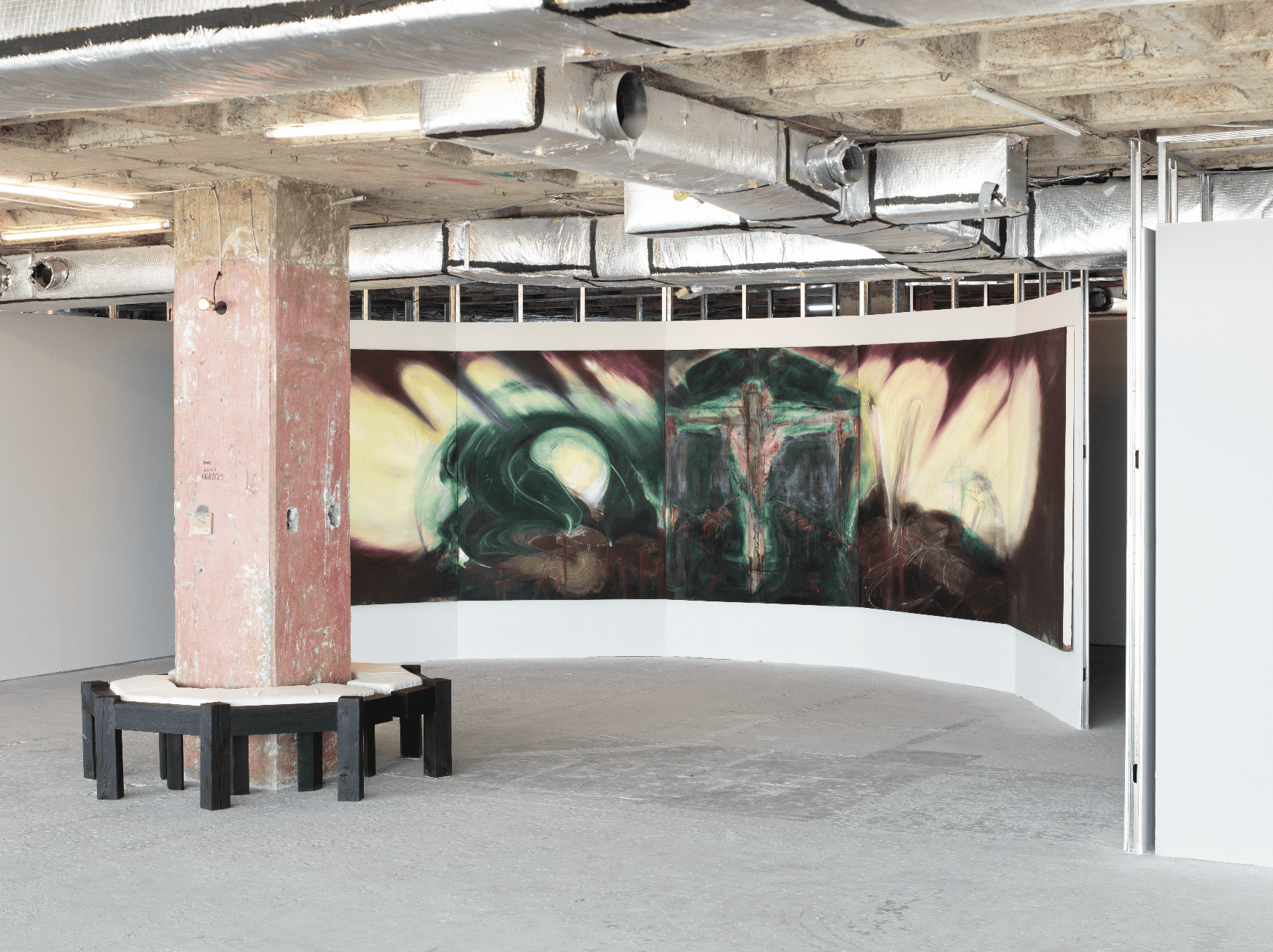
la ġalėría presents Everything You Touch Turns Into Stone by artist Azul Ehrenberg at San José del Cabo
“Everything You Touch Turns Into Stone” will be on view at la ġalėría inside the Los Cabos Sotheby’s International Realty office at Art House in San José del Cabo from March 20 to June 25, 2026.
.jpg)
During ABC Art Baja 2026, la ġalėría presented the solo exhibition by Azul Ehrenberg, Everything You Touch Turns Into Stone. The exhibition opened on Friday, March 20th on the first floor of Art House, a platform for contemporary art and design by Sotheby's International Realty in the Art District, in the heart of San José del Cabo. Art House is a project that seeks to preserve architectural history, promote the protection of regional species, and encourage artistic and curatorial experimentation. Originally built in the 1980s and later renovated in 2024 by architect Piero Demichelis, Art House proposes a space for dialogue and reflection at the intersection of culture, tourism, and the environment in San José del Cabo. The design of the house integrates local elements and species, including plants endemic to Baja California Sur and coral recovered from the pier after Hurricane Odile.
Baja California Sur is a territory of extraordinary natural richness, currently under tension due to the constant expansion of urban areas and tourist developments. It is within this context that the exhibition invites reflection on the fragility of natural ecosystems and our responsibility to inhabit them ethically. Azul Ehrenberg's work explores the boundaries between imagination and reality — boundaries which, in Everything You Touch Turns Into Stone, she uses to propose a spontaneous way of approaching the question: What does it mean to navigate a territory in the midst of transformation?
.jpg)
The exhibition was conceived specifically for San José del Cabo and is the result of an expedition to study endemic plants of the region, during which Ehrenberg collected plants on the brink of extinction, remains of extinct plants, and several rarely sighted species. Through the digital manipulation of botanical archive photographs and their reproduction on handmade paper crafted by the artist herself, Ehrenberg blurs the boundary between the real and the imaginary, making it nearly impossible for the viewer to determine whether the species depicted is real or fictional. It is precisely this blur between reality and imagination that opens the door to the artist's intuition and inner vision. In the words of the gallery's curator, Nina Westall: "Azul is always trying to push the boundaries between imagination and reality. In that pursuit, she also plays with what is apparent and invisible, what exists and what does not, what was once there and is no longer." Walking through the exhibition, one might ask: how much of what exists in nature truly still exists? How much longer will it continue to exist?
Azul Ehrenberg works primarily with natural materials — such as agave and tulle — making her own paper by hand. By combining contemporary reproduction techniques, such as digitization and printmaking, with traditional and artisanal pictorial methods, her work offers multiple layers of interpretation. Through intuition, the artist seeks to confront the viewer with themes of the ephemeral, the enduring, nostalgia, and the act of remembering. Nothing in the exhibition is casual or coincidental. The acrylic frames encasing the works — an interesting contrast to the delicate handmade paper — are reminiscent of fossils, echoing nature's innate function of self-preservation. It is almost as if the artist perceived her own works as a mechanism for cultural preservation; a mechanism to help us recall that we exist within the natural environment and not apart of it, that we must confront truths about ourselves that we sometimes choose not to see. Speaking about the artist's sensitivity and intuition, Nina Westall notes that "this intuition she has [referring to Azul] is extremely astute, and it feels very evident in this exhibition. The exhibition was conceived with a desire to invite people to reflect on the impact that human beings have on ecosystems, specifically in Baja California Sur. A desire to express that if we are not careful, it could disappear at any moment. […] The intention is always to confront the viewer with uncomfortable truths in a subtle way."
.jpg)
The depth of Azul Ehrenberg's work, and the multidimensionality of her practice, stems in part from her multicultural background. Born in 1997, Ehrenberg divides her work between Mexico City and Amsterdam. Having grown up between Mexico City, Baja California Sur, and the Netherlands, she was able to witness urban growth without being fully immersed in it, making the overwhelming deterioration of the territory obvious to her. Moreover, having grown up in such different contexts, the artist is able to articulate contrasts at both a conceptual and a technical level. Another example of Ehrenberg's artistic sensibility is her solo exhibition El Futuro Siempre Será Brillante, which opened on November 15, 2024 at Gallery Van Fanny Freytag, where she plays with the concept of the lottery as a symbol of hope, illusion, and disillusionment. Once again using paper as both material and symbolic medium, Azul explores social inequality and the ambiguous promise of escaping it.
Everything You Touch Turns Into Stone can be visited at la ġalėría inside the Los Cabos Sotheby's International Realty office at Art House, Álvaro Obregón and José María Morelos, in San José del Cabo, B.C.S., from March 20 to June 25, 2026.
.jpg)