Constelaciones y derivas: La Colección FEMSA celebrates its 50th anniversary with a critical look into Latin American art
Constelaciones y derivas: arte de América Latina desde la Colección FEMSA is open to the public at the Museo de Arte Contemporáneo de Monterrey (MARCO) through August 9, 2026.

The FEMSA Collection celebrates its 50th anniversary with the exhibition Constelaciones y derivas: arte de América Latina desde la Colección FEMSA. The collection, as collection curator Alberto Díaz Suárez tells us, originated in 1977 with the donation of the work Maizal Milpa-Azteca (1955) by Dr. Atl, gifted by Rosario Garza Sada de Zambrano to the Museo de Monterrey. The donation sparked an interest in building a Latin American art collection, which grew into what today is a holding of more than one thousand works of 20th and 21st century art. Magali Lara, Ángel Zárraga, Gego, Cruz Diez, Ana Mendieta, Helena Escobedo, Diego Rivera, José Alfaro Siqueiros, and Ángela Gorría are among the artists whose work forms part of the FEMSA Collection. The collection does not simply seek to accumulate works, but to tell the story of the institution, its territory, and everyday life through the artworks that are added to it over time. What story of Latin American art are we telling, and which story do we actually want to tell? What are the stories that have been left at the margins? These are the questions the curatorial team of Constelaciones y derivas posed when selecting the 177 of the exhibition.
Although there is no strict curatorial concept, the way the exhibition is organized seeks to make transparent the curatorial and acquisition work the Collection has carried out in recent years. When a piece is considered for the collection, a process takes place that curator Alberto Díaz Suárez calls "constellating the piece" — that is, tracing the dialogues a given piece holds with other works in the collection. By expanding this act of "constellating," the idea emerged to organize the exhibition around five axes or "constellations" (Territorios, Estructuras coloniales, Debatiendo la Abstracción: geometría y forma en América Latina, Alquimia and Identidades) drawing on research by María Carmen Ramírez and Héctor Olea, with museographic intervention by Max von Bertz and Mauricio Mesta. This research seeks to understand Latin American art not as derivative of European or North American art history, but on its own terms and with its own questions. Alberto Díaz Suárez speaks of the permeability and flexibility with which the constellations allow a collection to be read: "This idea of constellations allows us to speak of permeability — there is no single linear history. Works like those of Ana Mendieta can belong in the constellation of Territorios as much as in that of Identidades. The constellations allow for a flexibility of understanding and possible readings. The exhibition is not a historical review of the Collection, but rather seeks to pose questions around the constellations of alchemy, colonial structures, territories, and identities in Latin America, which have been shifting over the last two hundred years."
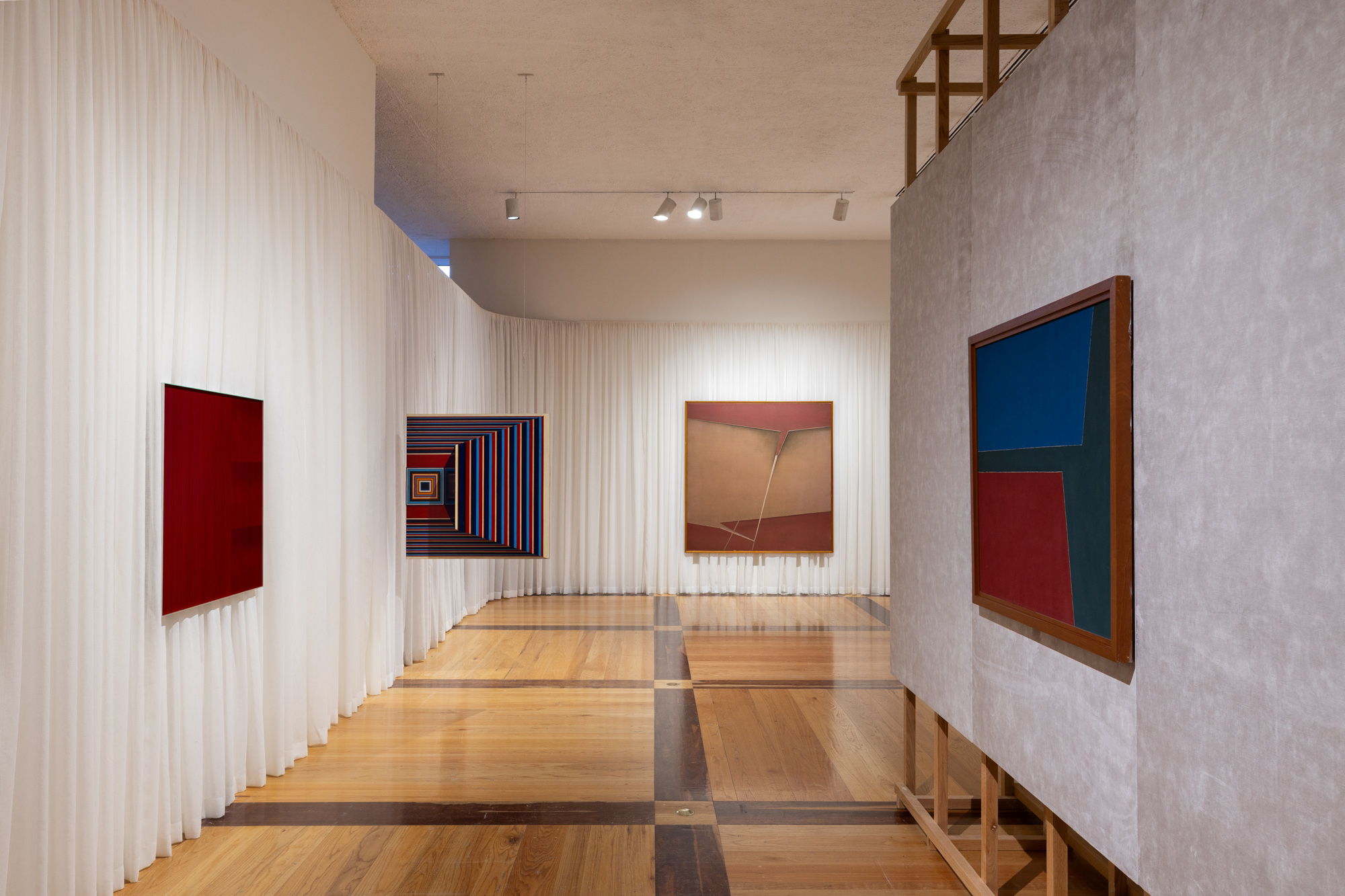
But what does it mean to produce art that is not derivative of art history's established narratives? Díaz Suárez suggests that the axis Abstracción: geometría y forma en América Latina is itself an act of reflection that regards Latin American art as a history in its own right. "Abstraction already existed in Latin America long before. We can find it in Andean textiles and in pieces that predate these movements [the European avant-gardes]. Shifting the focus and understanding [abstraction and geometry] from their Latin American origins — thinking beyond the canon of Europe and the United States. […] What we hope for from this exhibition is that people encounter their own questions, their own answers."
The breadth of the concepts in each of the exhibition's axes encourages open, non-prescriptive questions. The Territorios axis, for example, is remarkably wide and rich in meaning. When we speak of territories, which ones do we mean? From what time? If we take geological time as a reference, the cadence and duration of events are far slower than those of human history and the human body. In Latin America, the experience and worlds of each individual and their territory are so diverse that, according to the exhibition's curator, it would be difficult for anyone to speak of a single type of Latin American territory — one can speak only of its diversity, its rootedness, its transit, and how we inhabit it. Alchemy, for example, is another constellation that is difficult to define, yet closely related to Territory. Alchemy has to do with the notion of change that recurs throughout the history of things. Everything is in constant transformation; our territory, the beings that inhabit it, materials — everything transforms and degrades over time. And yet, to speak of change is also to speak of the encounter between opposing forces, which in Latin America can be read through its great contrasts: day and night, the so-called masculine and feminine forces — forces whose encounter gives rise to something new. "The notion of alchemy interested us as a way to speak about colonial structures, territory, and identities. We felt it was a constellation that touched several of the others and served as a hinge, because it is also very closely related to abstraction."
The selection process for the exhibition was a research process that lasted approximately two years. Despite the arduous work of selection, the curatorial team describes it as an emotional process in which they encountered — or re-encountered — the works. In addition to the process of observing each piece and "constellating" them as a whole, the collaborative curatorial seminar was key in shaping the final exhibition. Theorists, artists, and activists were invited to reflect on the axes of Constelaciones y derivas, representing an extremely diverse range of profiles. Among the seminar participants, the work of Ana Eugenia Rodríguez stands out, whose contribution around gender and sexual diversity was fundamental to the reflections on the Identidades axis. The seminar, which lasted several months, not only gave shape to the exhibition but also provided structure for the exhibition's public programming.

We asked the curator which work he would choose from each thematic axis of the exhibition. Although it is difficult to select just one, some highlights include the Siluetas series by Ana Mendieta for Identidades, the work of Salvador Xharicata for Estructuras Coloniales, certain pieces by Ángela Gurría for Debatiendo la Abstracción, Remedios Varo and Circe Irasema for Alquimia, and finally Abraham Ángel for Identidades. This selection of works evokes in the curator thoughts around the mystical dimensions of territory and identity. "[These works] have a mystical quality. For example, in the Ana Mendieta and the Circe Irasema, [the subject] is looking up at the sky… It is this irremediably human act of looking up at the stars and making a wish. There is something I also find very intimate about all of those pieces. I think they are asking questions about what it means to experience being human, to look up at the sky… The body and the earth with Ana Mendieta, Xharicata questioning the Purépecha legacy he no longer has access to, Abraham Ángel questioning his identity as a queer man at the beginning of the 20th century… And finally, the Ángela Gurría is a piece in which two forms meet in a smaller form. All of these works make me think about that experience of asking ourselves who we are and how we inhabit this planet."
The exhibition Constelaciones y derivas does not seek to define the essence of Latin American art — if such a definition is even possible. Through its constellations, it seeks to encourage visitors to reflect on which questions feel relevant to them, and what possibilities those questions open up. That, according to the curator, is what makes the experience of art so powerful: that the meaning of works changes for each person who encounters them. In this sense, the history of Latin American art is defined in the gaze of each viewer.
Constelaciones y derivas: arte de América Latina desde la Colección FEMSA is open to the public at the Museo de Arte Contemporáneo de Monterrey (MARCO) through August 9, 2026. The general public is also invited to attend the activities, workshops, and panel discussions of the public programming organized by Cristian Gómez. More information about the public programming can be found at www.coleccionfemsa.com