El Zoológico de Moctezuma by Christian Poiré: A conversation with Daniela Garcia on rites, aesthetics and colonization
El Zoológico de Moctezuma, by Christian Poiré, was exhibited during ABC Art Baja, initially at Hotel Drift in room 302 in San José del Cabo, and at the Paradero sanctuary in Todos Santos this past March 2026.
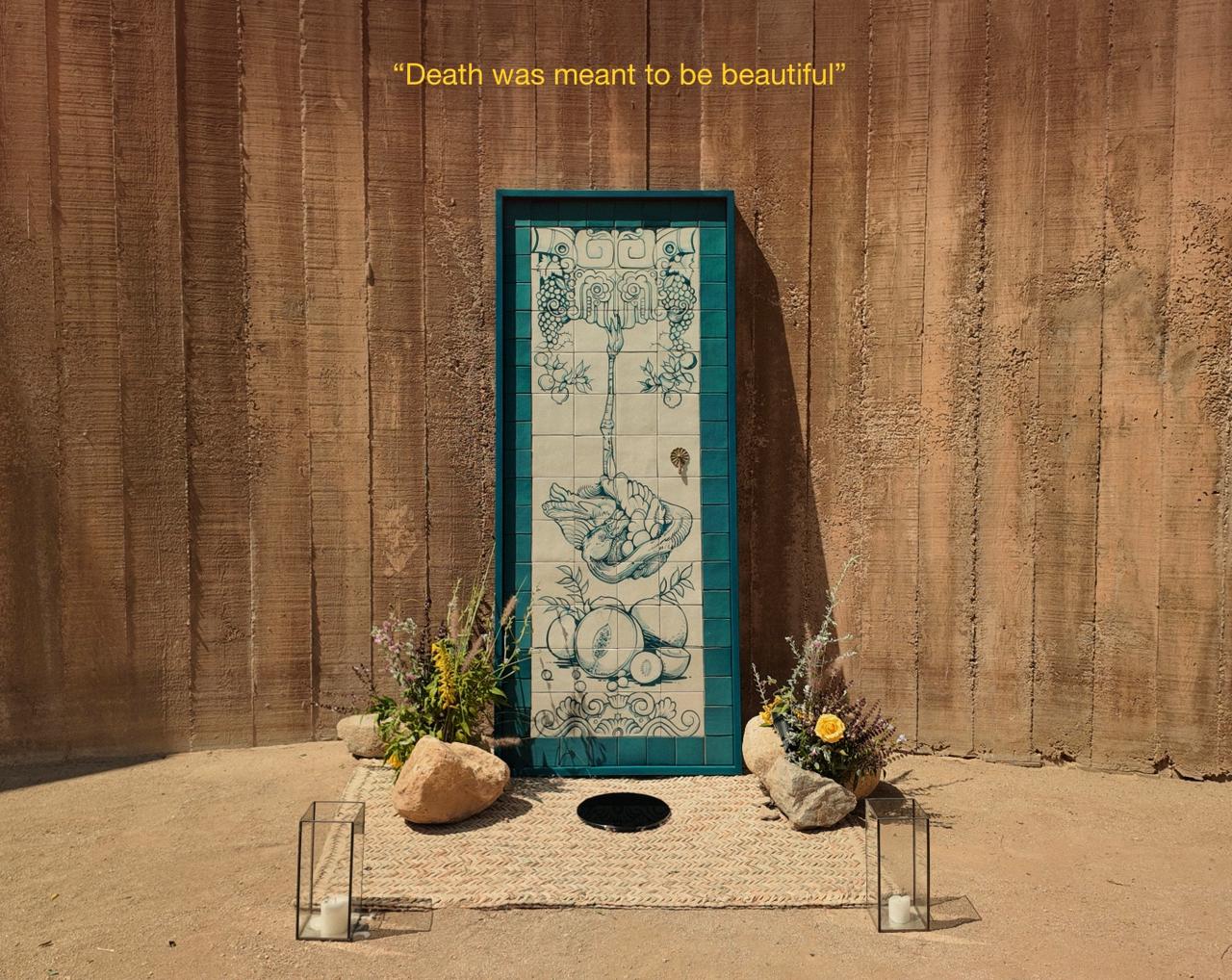
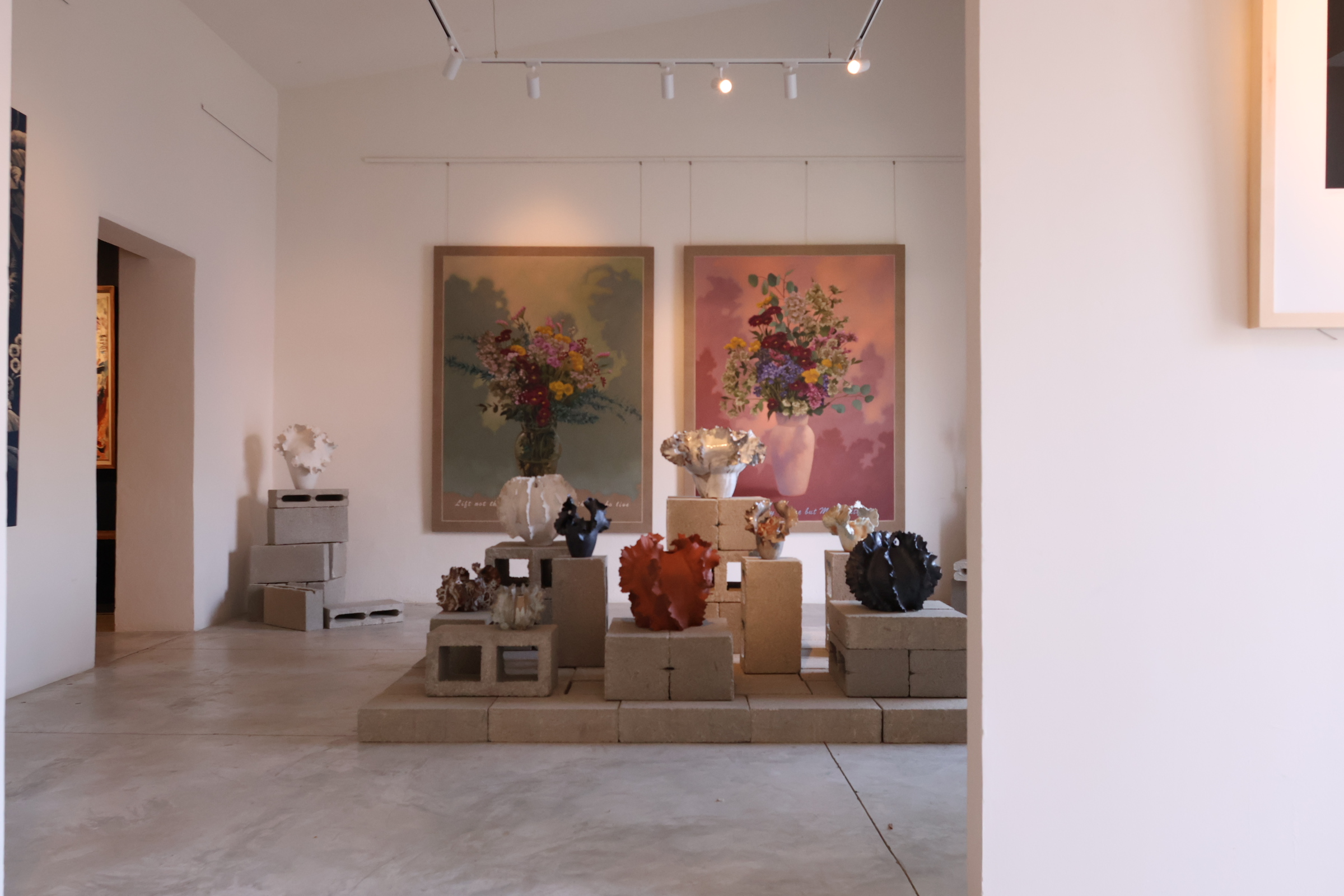
Within the framework of the ABC Art Baja 2026 festival, the gallery Amvleto presented new works by artist Christian Poiré in his solo exhibition El Zoológico de Moctezuma. This exhibition represents the culmination of Poiré's artistic research project, which reflects on the intersection between ancient and modern myths — the tension between history and fiction that sustains contemporary narratives. The selection of works includes paintings made with mixed techniques, including oil, collage, graffiti, mosaic, and ceramics. Among them, La Muerte debería ser hermosa (2026) stands out: a high-temperature fired mosaic door featuring motifs of animals from the mythical zoo of Moctezuma, destroyed — according to the legend — by the Spanish during the Conquest. The composition of the work is inspired by still lifes from the Portuguese and Italian tradition, which, in juxtaposition with motifs from Mexican legends, presents a strong narrative, aesthetic, and artistic proposition that requires little explanation to evoke in the viewer a sense of mysticism, mystery, and fascination.
We spoke with the exhibition's curator and founder of Amvleto, Daniela Garcia Romero, about her gallery, her relationships with the artists she collaborates with, and the work and inspiration behind El Zoológico de Moctezuma.
Orbita: Amvleto reflects on artisanal and social techniques drawing from the concept of the amulet. Could you tell us more about the project?
DGR: Amvleto truly began from a feeling, a very personal and familial feeling. It comes from an interest in reflecting on the meaning of the amulet and the alchemy it represents. This interest led me to collaborate and build this project with communities of artisans and artists, migrating toward what is today the representation of contemporary art, carrying the amulet as an emblem of what it represents for us as a society and as a community.
Orbita: In terms of contemporary art, how does the essence of an amulet define your relationship with the artists you work with?
DGR: The research has revolved around artistic projects that make sense in relation to the place where I find myself geographically. We started in San José del Cabo and now also in Todos Santos, with a point of sale in Costa Palmas, in La Ribera. Primarily, what matters to me is that the artists I work with understand the cultural significance of what an amulet represents; how their creative process works, what identity they have with contemporary Mexican art, how they are projecting themselves externally, and what their social communication looks like. That is to say, whether they give workshops, promote culture, education, and collaboration — this is something extremely important to Amvleto's values. Because that is the way an amulet is shared; through society and community.
Even when we have worked with artists from outside Baja California Sur, the culture of the north prevails. Their experience as contemporary Mexican artists enriches the dialogue with the cultural and social development of the region, giving rise to new trends in artistic appreciation, collecting, and representation, opening the dialogue not only in the local scene but also on the international stage.
That is a large part of what I am interested in projecting through Amvleto. Further along, we hope to have pop-ups in Mexico City or other parts of the country, but for now, that is my greatest interest — one that has aligned with Christian's work in this exhibition of El Zoológico de Moctezuma.
When Christian told me about this project and about traveling to the Museo de Antropología, about immersing himself in the stories of a legendary zoo burned by the Spanish, those are exactly the stories and perspectives that Amvleto wants to share. Moreover, applying his own technique and style, he represents them in a very elegant and contemporary way. Artists like Christian are emerging artists who are conscious of the history of the country in which they live.

Orbita: You mentioned that Christian already had this project in mind, in some way. How did the first contact with Christian come about? Where does this collaboration originate?
DGR: It was a very organic process. Thanks to a chance encounter, I met Christian at his tattoo studio. In his studio there was an oil painting, similar to old still lifes with chiaroscuro, which I found spectacular. In the painting, there was a tattoo machine and a quote that read: "Art for beginners." I felt he had a great deal of talent, and at that moment we both knew we wanted to work together on this project.
Orbita: Christian is quite well known for his tattoo work — many people would recognize him for that. How do you think his trajectory influences his work as an artist? What is it like working with him?
DGR: I am impressed. In Todos Santos we were receiving guests and visitors for the art walk, and many people recognized him: "Oh yes, Christian, who tattooed us back in Guadalajara," "Are you going to tattoo, what are you going to do?"
Christian has a creative process and execution in which every aspect of his work is loaded with meaning. He was involved in every part of the exhibition process at Hotel Paradero in Todos Santos — from why to show a particular piece, who we would work with, all the way to the documentation of the work. He is an artist who cares about the research and poetry that his work conveys. At the same time, it is important to him to involve his family: in the documentation of the process, in the writing of the texts — even his son was part of the process of creating the exhibition invitation.
Orbita: You were telling me about this connection between the artisanal and the historical with contemporary art, which is very evident in Christian's work. Oil paint, a centuries-old technique, mixed with something ultra-contemporary like graffiti and tattooing. As a curator, what draws you to the technique he employs in his works?
DGR: What draws me is the elegance of the execution. As a curator, I am drawn to the aesthetic, to the beautiful. We all have a different concept of beauty, but for me the elegance of execution is a form of beauty. The capacity to control perception — that people can say: "Wait, is that oil paint? I thought it was graffiti!" or "Wow, that natural landscape in the background... Why is there a bird-man and a fish-man against those natural landscapes?" From a curatorial standpoint it makes sense: we are exhibiting the collection in Baja California Sur, and the defining qualities of Baja California Sur are its landscapes. You don't quite know where you are — in the mountains, at the hot springs, at an oasis, or at the sea. Christian, with his work, speaks to you indirectly about concepts of colonization and politics. In a very elegant, very subtle way, he suggests an enormous amount of content that opens up many possibilities for conversation and observation.
.jpeg)
Orbita: How do you think the techniques Christian utilizes, collage for instance, connect contemporary narratives and issues with his work?
DGR: A somewhat personal response is that I think what the artist is proposing within the collage are very specific signals. In different layers, he is speaking of a political, social narrative that, through his technique and style, already constitutes an identity as an artist. Collage is this representation of the world of ideas, with an approach to global narratives yet grounded in very personal experiences.
Orbita: El Zoológico de Moctezuma is like this small universe, isn't it? Born from a legend, something that may have been, but probably wasn't.
DGR: That is a great question, because it was a process of many years of research into the legend of the zoo of Moctezuma. There is a very personal story involving his wife, Luna Iberri, and a series of events that led them to travel to Mexico City with historians. The precision with which Christian represents the zoo of Moctezuma and these research archives opens up our perspective on what was real and what was not. What was the myth? What actually happened, and why? This, I believe, is an approach to aesthetics.
Orbita: Definitely — awakening a curiosity and allowing the viewer to construct a world from their encounter with the works is itself an aesthetic experience.
DGR: Christian's artistic representation strikes me as a poetic, aesthetic, and highly technical form of political appreciation and engagement with the moment we are living in. It was spectacular to do it in Baja California Sur, because this is a key point in the country — and one of colonization, in fact; we are talking about an accepted conquest. There are foreigners building and developing in a region of incredible endemic richness, with unique natural landscapes, and it is being colonized all the same. Christian, through this zoo, raises all of these conversations that are current — about control, power, politics, and our natural environments. They are conversations about the meaning of power, about the act of domination, which at the same time speak to the beautiful, the aesthetic, and aspiration. In La muerte debería ser hermosa (2026), for example — this Portuguese or Italian-style still life door — there is also a weight of the artist's own appreciation of architecture, design, and globalization. It is impeccable, for me it is impeccable. That is why I am certain that this first exhibition, El Zoológico de Moctezuma, is a door that will take him very far as an artist.
El Zoológico de Moctezuma, by Christian Poiré, was exhibited during ABC Art Baja, initially at Hotel Drift in room 302 in San José del Cabo, and at the Paradero sanctuary in Todos Santos this past March 2026. The exhibition can be visited through June 30, 2026, at Amvleto Galería, located inside Hotel Grupo Guaycura, Legaspi s/n, Colonia Centro, Todos Santos B.C.S. It will also be shown at a pop-up in Mexico City in September of this year, with the exact location and date yet to be confirmed.