Christian Wedel, Sangre (óleo sobre lienzo 182x115) y Arch (clay fired in open pit, bricks 40x60x22cm). Photo courtesy of the artist.
This interest in capturing roughness, texture and decay comes directly from the urban environment characteristic of Latin America and the Caribbean. Visiting the artist's studio in the Santa María de la Ribera neighborhood, in Mexico City, he shows us the walls of a neighboring building visible through the window. On the walls, one can appreciate dampness and some mold and areas where paint or entire layers of the wall have peeled away. The climatic conditions of the region and moist environments, which favor the development of mold, leave a trace on the urban landscape, whose aesthetic quality inspires Wedel's pictorial practice. He explains: "I don't know, it is as if they had painted directly on the wall, almost as if they hadn’t prepared it beforehand, but rather kept painting one layer on top of another and a whole lot of textures were created. For example, there you can tell mold is forming up from moisture. I feel that in the Caribbean it is common to see fungi taking over spaces, making everything a little rough. I really like that."
The brushes and materials the artist uses also help capture the earthy quality of the Caribbean. Wedel uses frayed and stiff brushes — even somewhat worn — to create irregular lines, and spatulas to apply thick layers of paint and scrape them away: "I have a brush that is my favorite, but it's a shame because I think it's already dying, it has maybe only three hairs left [laughs]. With this one I can make a whole lot of lines that are impossible to define. Chance has a lot to do with my work. I like to put paint on and pull it off, so that things don't look completely clean."
The experience of living in Mexico City, far from his country of origin, has allowed the artist to rediscover his roots and reinforce the appreciation he feels for his life in Costa Rica. Life in Central America, in contact with the rhythms of nature, constantly returns in the form of lightness that the artist seeks to represent in his work: "There is also a way of painting that has a kind of freedom, let's say… It's not so rigid. In these paintings specifically I'm interested in there being a kind of lightness in the form, which for me expresses what it means to be Latin American, from Central America. It's not exactly naïf that I'm looking for, but rather that it doesn't stem from a realistic European technique. I'm interested in rediscovering how I want to apply paint. […] The forms I think about and then paint always bring me back to the place I come from. Working with this kind of detail, where things are not completely clean, is very important to me."
Science fiction, mythology and time are other themes that interest the artist. Speaking about the temporality of his creative process, the artist coincidentally describes the theory of daydreaming and creative writing of the renowned psychoanalyst Sigmund Freud. In summary, Freud, in his essays on creativity collected in the series Creative Writers and Daydreaming (Der Dichter und das Phantasieren, 1908), describes that the creative writer lives in three different temporalities in order to convey an emotion or idea — a present moment triggers a memory from childhood or the past, which in turn projects toward a future idea. The artist describe his own experience in this way: "I feel that in painting one is in a very strange place. One is in the past, thinking about things one has lived, one is in the present because [painting] is an act of great presence, but one is also thinking about getting somewhere, toward a future work. At the moment of painting one is in those three moments at the same time, which is quite strange." The artist's interest in reimagining a landscape where human and plant bodies are confused comes from a fascination with the meticulous world-building of Ursula Le Guin — an American author of the science fiction genre —, Greek mythology and Latin American legends, especially Brazilian ones. A plant that has been a great source of inspiration for the artist, and which he himself describes as almost "alien," is the breadfruit tree, or jackfruit: "The breadfruit is a tree I love, there were many in front of my house. You can eat it, but sometimes it even looks intimidating. I like that the fruit has those little spikes, that the leaves look like hands and that they are very tall. You see a tree with a whole lot of hands and these strange fruits. I don't know, it seems like a very alien plant to me."

Christian Wedel, recent work. Photo courtesy of the artist.
Natural phenomena and proximity to the natural world is another important source of inspiration. The artist describes the closeness to these events as magical, attributing an animist character to natural elements in his pictorial practice. The characters, if we can call them that, in Christian Wedel's paintings evoke an alternate reality where palm trees, water and rocks come to life. "It truly rains a lot, the roof is falling in on you. Then in the early morning hours, you hear the rain stop and when dawn breaks, after four days of rain, all the animals come out, the rivers carry objects and debris to the beaches… It is a very magical moment. That painting [Palmera descansando, 2024] reminds me of that moment; the palm trees are fallen, as if fainted, and then they are born again. Almost all the magical moments that I have experienced like that have been in nature."
The magic that the artist observes in nature is not only represented in his work, but is a way of absorbing the world that accompanies him in his daily life. Despite the chaos that persists in Mexico City, during his stay in the capital he has managed to find places to be in proximity to nature, such as Lago de Chapultepec. "Before the auction I was nervous, to be honest. I stayed walking around the lake and noticed that there are a lot of fish, and also herons along the shore. I was watching how the fish had to jump over a small piece of concrete to get to the other side… The act of simply observing, of simply contemplating something happening in nature and just being there, without any pretension. […] I think nature is that space of just observing something that is not oneself." And that is precisely what Christian Wedel achieves in his work; the capacity to absorb the experience of simply existing as part of nature — not apart from it —, and to create windows onto a world where form invites us to imagine different ways of relating to our surroundings.
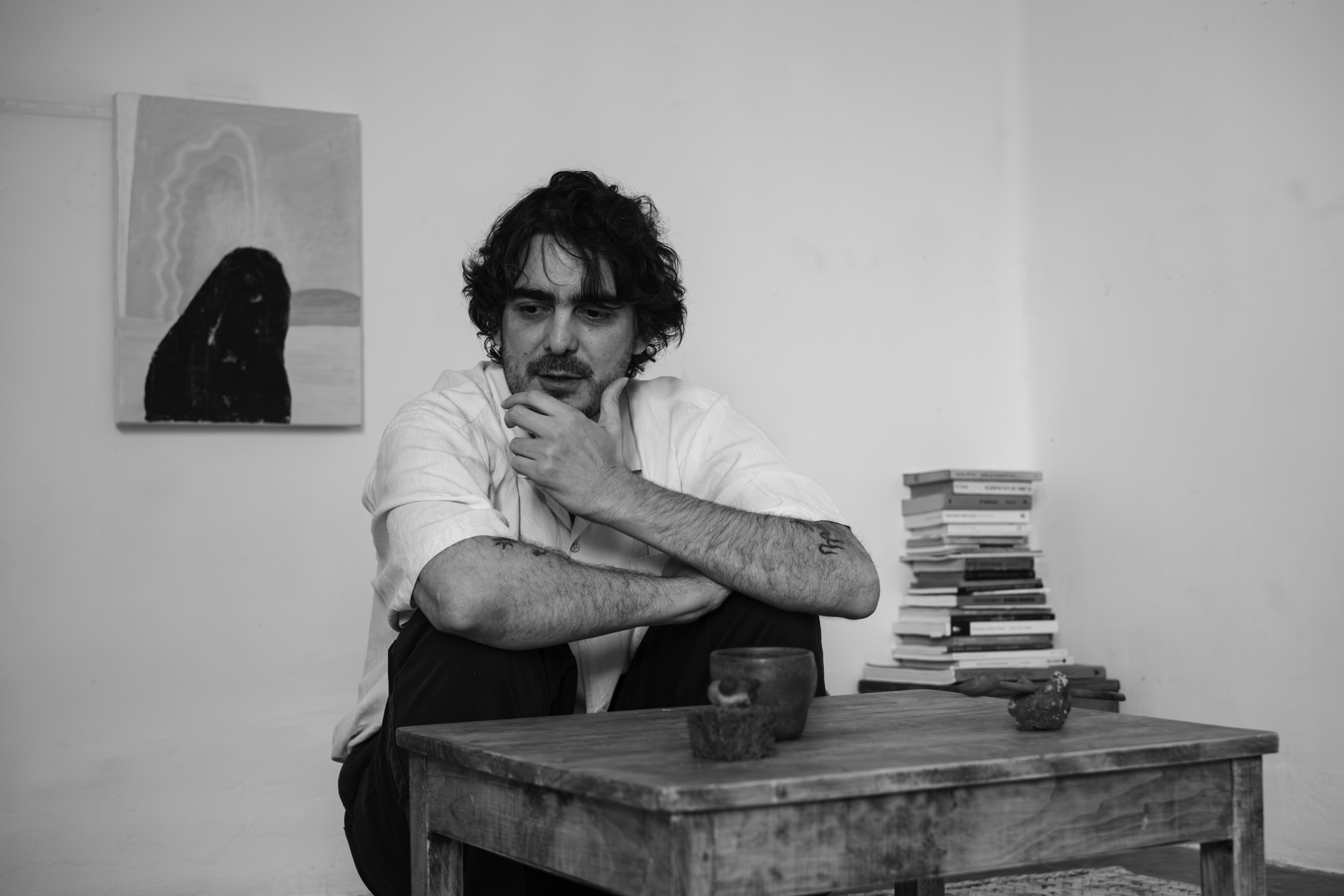
Christian Wedel, born in San José, Costa Rica in 1985, is an artist whose pictorial work studies the way in which plants, humans, materials and environments relate to one another. Some notable projects include Livable Worlds, Tropical Futurology, The plant as a form, and A town for plant people, projects that have received support from institutions such as the Centro Cultural de España en Costa Rica (CCE) and the Museo de Arte y Diseño Contemporáneo de Costa Rica (MADC). His work has been exhibited individually and collectively in multiple venues in Mexico, the United States and Costa Rica, including Base Proyectos from Salón Acme, Subasta Terremoto at LagoAlgo, PEANA, Galería Municipal, Estudio Croma, Craig Krull Gallery, Cero Uno, among others.

.jpg)