Portraiture, Nostalgia, and the Public: An Interview with Culeybo, Resident Artist at Espacio Cabeza

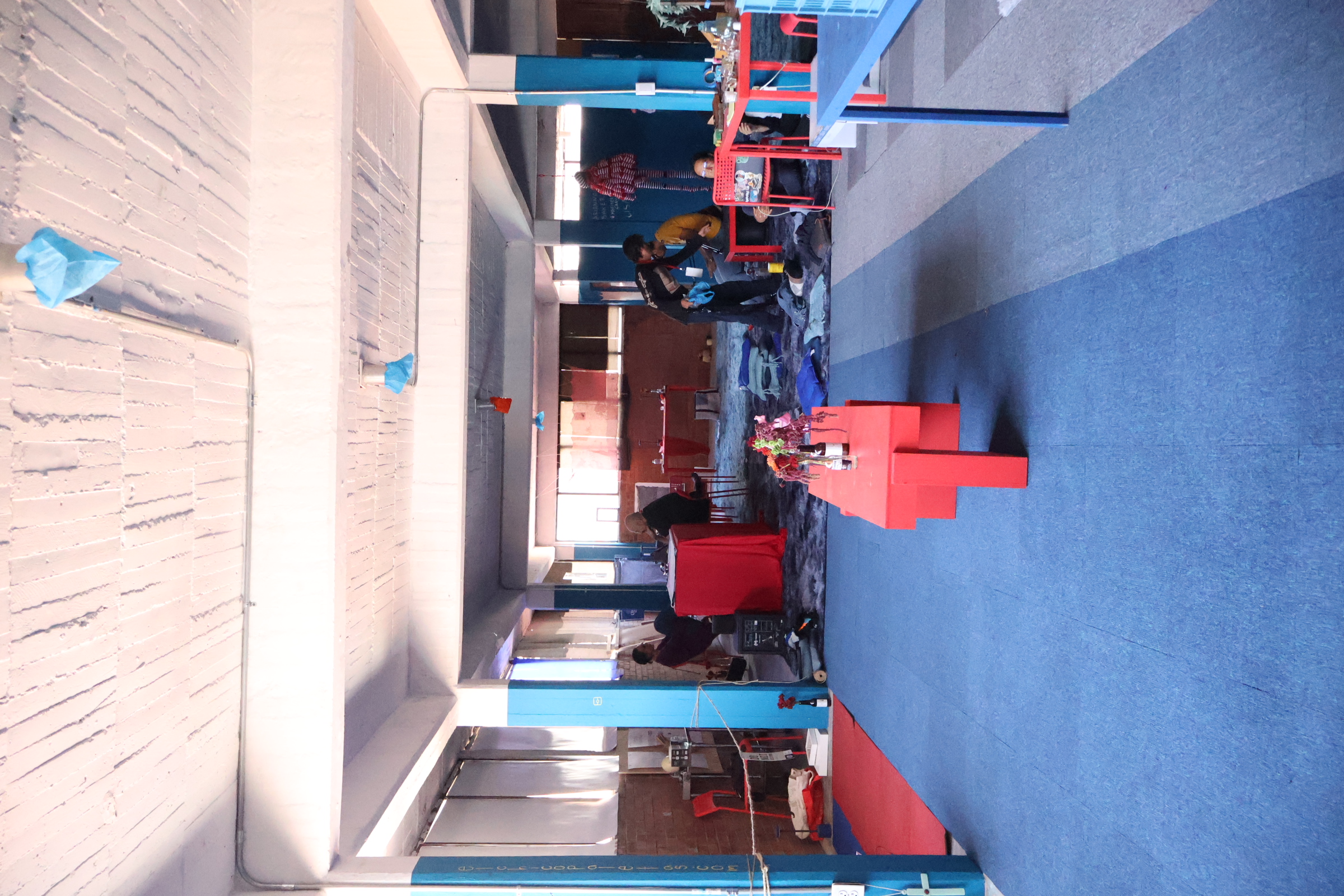
Sebastián Gutiérrez, better known as Culeybo, the nickname his family gave him as a child, explores the relationship between the personal, the public, and the desirable in his painting practice. The interview begins in one of the exhibition rooms at Espacio Cabeza, temporarily converted into the artist's studio and workshop, as he was completing an artist residency with the independent space at the time of recording. His reflections on the personal and the intimate stem from the Puerto Rican artist's long-standing interest in portraiture and in tactile materials such as oil paint and unusual or "vintage" objects.

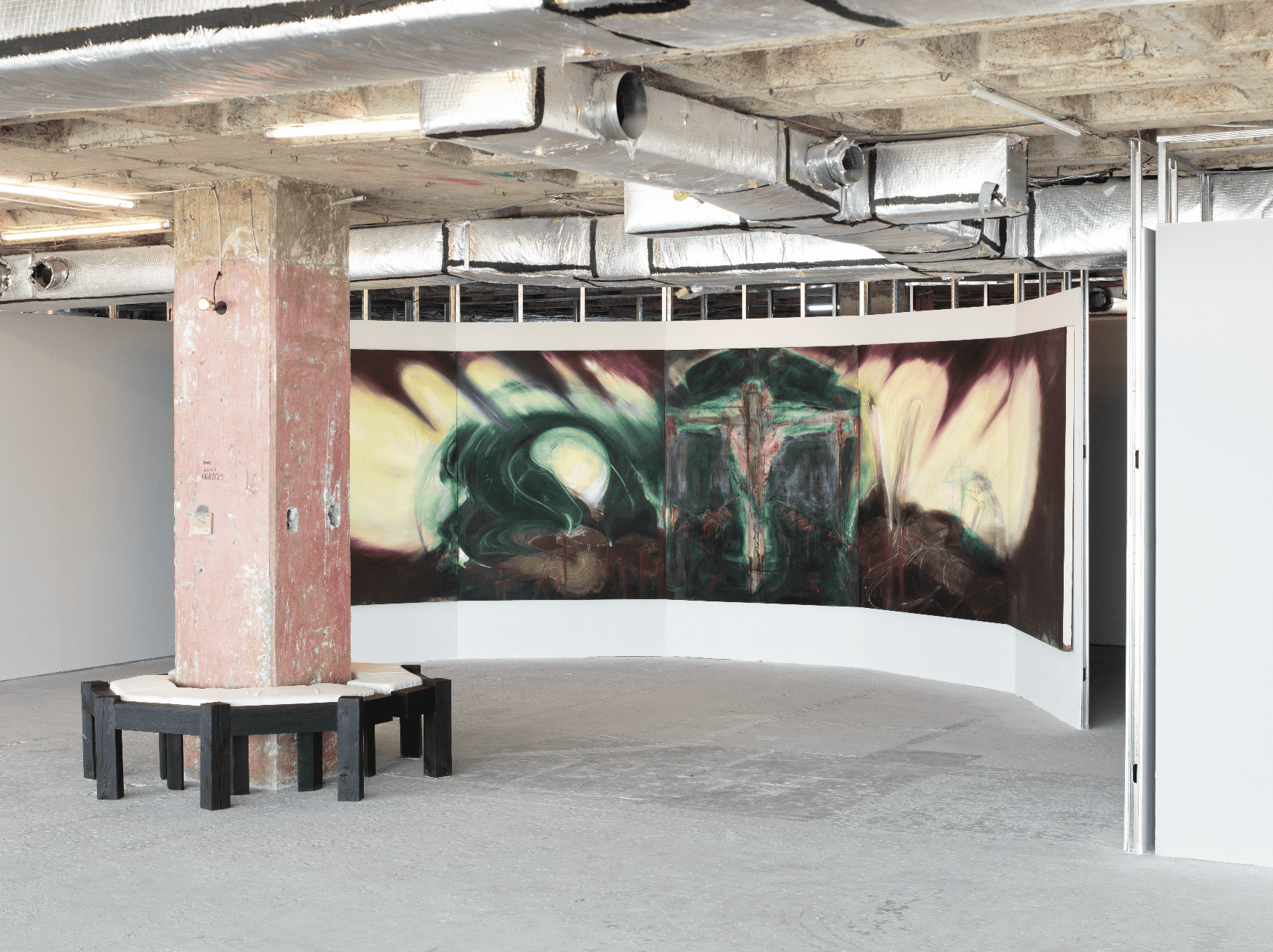
"Parque Manantial" (2026) by Culeybo. Installation view at Espacio Cabeza.

Before becoming a full-time artist, Culeybo worked as an interior designer in Texas. One of the main activities he recalls is the intensive work with upholstery and with papering walls and surfaces. Working for an interior design firm, where the censoring of his own individual expression and the prioritizing of work for clients, or the public, that is, for others, was a barrier he had to overcome at the start of his artistic career. His play with portraiture and censorship, and his experience with sewing and upholstery, were crucial elements in the development of his work. "The field I worked in censored [my work] and motivated the theme I wanted to start working on at that time. This was when I started making a series called 'Inner Beauty,' a series of interactive, tactile portraits in which, when you look closely, you can see the interior or the features of the person in the portrait." While working on this series, Culeybo was leaving behind his work as a sex worker in Puerto Rico, an experience that informed his work as much as his design experience did. Sex work, the artist tells us, turns private life into a form of public life, leading him to approach themes of private life, identity, gender, queerness, and sexuality. However, for the artist it is not only the duality of the private and the public that is highly visible in his work, but it goes hand in hand with another duality: comfort and discomfort. "As an interior designer, I began to get involved in private spaces and residences where people live. Functionality and comfort started to matter a great deal to me. […] It was a job where I had to be extremely considerate and empathetic, where there is a process of studying the dynamics of the home."

From the series "Inner Beauty" by Culeybo. Photo courtesy from the artist.

One of Culeybo's great sources of inspiration, in relation to gender, is women. The artist's mother was a single mother, and the way she raised him influenced his visual interests. "I love curiosity and I love the power that women have. I don't know if it's right to say, but I think they are much more important than men. When I started working with other sex workers and got to be much more involved with drag queens, the showgirl aspect and the entertainment world with women at the center seemed really beautiful to me. I like to integrate that world of entertainment where it's fine to combine the extremes of elegance with vulgarity or the 'disgusting.'"

The artist works mainly in series, aiming to explore micro-themes by extrapolating the absurd through drawing techniques he uses for tattoos and through caricature, which, as he explains, serves to explore a micro-theme and take it to the extreme. One of the "super absurd" themes the artist developed into a series is "Los perri-dientes" ("Dog-teeth"). The artist tells us that the word "perri-dientes" could appear in a Puerto Rican urban dictionary, and that it comes from a campaign by the dog food brand Pedigree around 2010. On large-format billboards, dogs were shown with boxes that looked like teeth, implying that if people didn't buy their kibble, their dogs' teeth would fall out. Coinciding with a time when people had begun getting cosmetic dental procedures, often poorly done, it was colloquially said that these people had "perri-dientes." In response to this phenomenon, Culeybo created a series of thirty-two giant wooden teeth, each with a portrait of a rabid dog and a resin relief simulating a smile. The dog, rabid. The mouth of a person, laughing. A juxtaposition in which the artist questions why we expose ourselves to surgical procedures. "It was like this whole matter of pointing out the popularity of this dental work, in relation to the importance of vanity in popular culture today versus the importance of oral health. Health is important, but I was also wondering what the real function of teeth is. Are teeth for chewing, or are they for smiling, or are they for both? Or, what is the hierarchy of the tooth's function?"

From the series "Perri-dientes" by Culeybo. Photo courtesy from the artist.

During his residency in Guadalajara with Espacio Cabeza, Culeybo revisits nostalgia and elements of his childhood to problematize tourism and gentrification, which affect tourism-based economies like Mexico's and that of his native Puerto Rico. "When I came to do this residency at Espacio Cabeza, it seemed powerful to work on a theme related to that. In Puerto Rico right now there is a process of deforestation, water scarcity, and deterioration of critical infrastructure like aqueducts, which is contributing to the disappearance of public spaces."

By intervening in "vintage" oil paintings with brightly colored water slides, the artist reconsiders happy moments from his childhood that are, paradoxically, part of global and complex processes of displacement of local people and of value. "It makes me nostalgic to think that when I was little, in the nineties, my family and I went to water parks. It's funny to feel nostalgia for something that is itself ecologically problematic, because it's a park that wastes water. For water parks to exist, the area where they are built goes through an enormous process of deforestation. [Water parks] don't have a negative aspect in the public eye, but it makes me think that I miss these parks from when I was little because now I simply have no water and no park and no tree, something I associate with a very individualistic way of life."

To emphasize the aspect of gentrification even further, the intention was precisely to find anonymous artworks in secondhand markets. The artist intervenes with water slides in the landscapes of these works, which he describes as clichéd, rural, mountainous, but mainly distant, and which sadly may have ceased to exist because of urbanization. Culeybo creates a powerful and painful allegory, making evident that the spaces that thrilled us in our childhood are in fact a manifestation of processes of dispossession. They are not neutral spaces of recreation, but turn entire areas into exclusive places of consumption. The exhibition "Parque Manantial" is open to the public at Espacio Cabeza until November 7th 2026.

Get your daily dose of theory on design, art and tech—directly to your inbox.

Subscribe to our newsletter to receive The Orbiter, our monthly digest of what's new in the creative and inventive landscape.