A view into Gordon Massman’s “primal” creative universe

Massman studied literature and creative writing at the University of Texas-Austin and the University of Alaska Fairbanks. He taught writing and literature at The Massachusetts College of Liberal Arts in North Adams, MA, and is the published author of five poetry volumes, having composed thousands of poems over a span of forty-five years. Massman has exhibited in the United States, and his work is in the collection of the deCordova Sculpture Park and Museum.

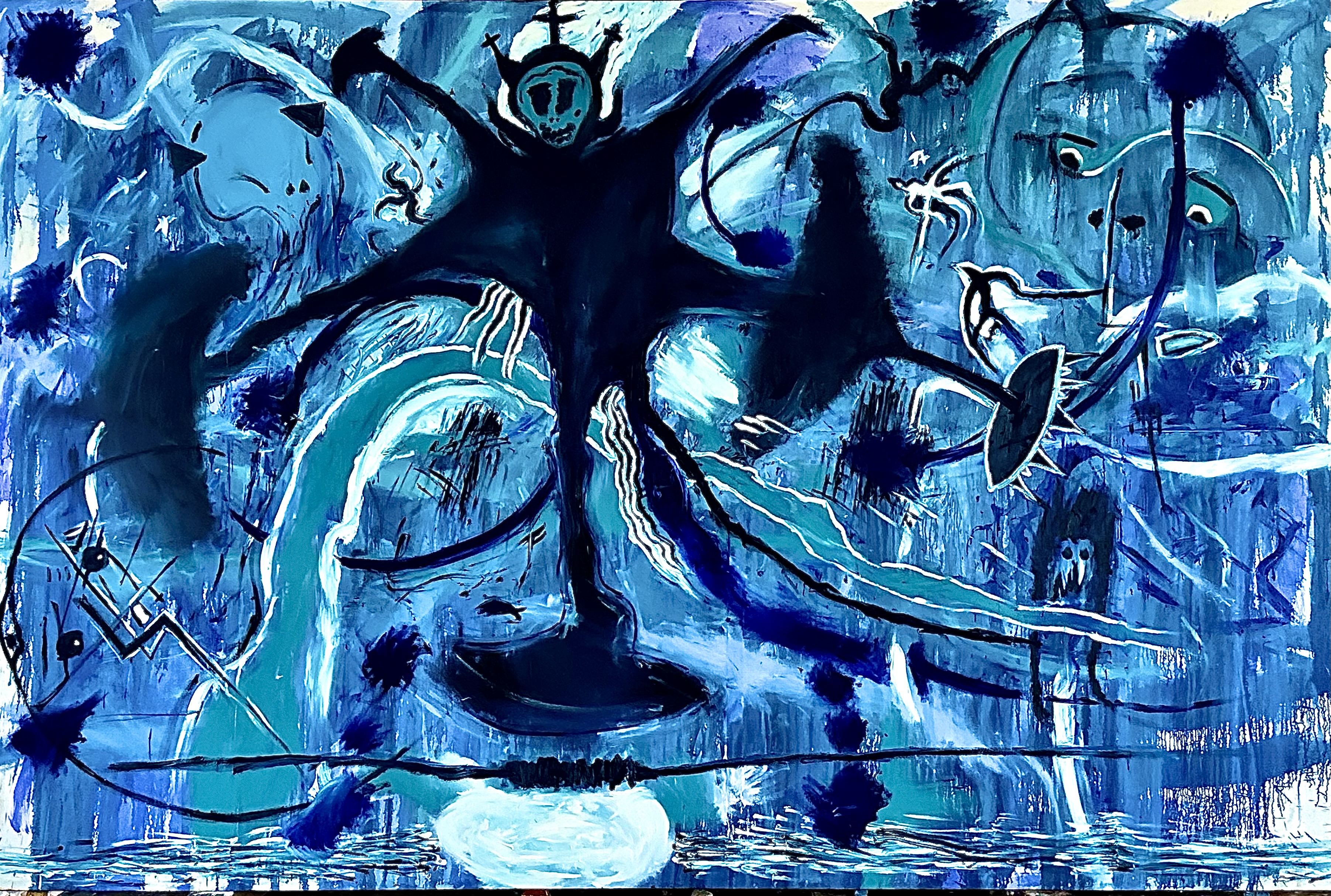
Gordon Massman, “Bluebird Drowning” (2026). Courtesy from the artist.

Our editorial point of view stems from the uncomfort of waking up to a digital culture where art and creativity have been reduced to economic utilities that, to quote Sam Altman, people can “buy on a meter”. Everything is valid – as long as it can go viral or generate revenue. The difference between slop and art, by this measure, is none. There is no truth, no beauty, no craft. The same existential and postmodern values that enabled a relativist appreciation of all art forms have turned against us, surrendering aesthetic value to the algorithm’s decree, where virality is the only true measure of worth. It is this reality to which we take a stance against, a stance shared by artist and writer Gordon Massman. Via a series of email threads, Massman, an experienced poet and self-taught artist, expands upon his practice and experiences as both a writer and an artist while explaining his views on AI. He describes AI as a means to “cheapen and simplify human emotion, stripping out its soul for the sake of clinical ‘perfection’.”

It is precisely an obsession with simulated ‘perfection’ that pollutes the creative process when using generative tools. Aesthetics, art, and visual culture is, to generative tool enthusiasts, nothing more than a problem they can optimize a solution for, a ‘perfect’ method to control time and resources. In optimizing The Image towards ‘perfection’, its meaning becomes dull. Profound, lasting art is about a total surrender of control, as the artist puts it, “one does not become a profound artist by choice. Profound art chooses its human.”

Massman’s work focuses on the primal feeling of lived experience. In Massman’s universe, impractically large canvases depict emotions such as fear of worthlessness, meaninglessness and death, as well as distressed subjects. We start this interview by diving into the artist’s experiences and the source of his creativity. In describing how writing is related to his practice, Massman quotes the first century roman satirical poet Juvenal: “When talent fails, rage writes poetry.”

Writing is not the main source of influence to his practice – it is rather deep emotional distress that fuels his creative universe: “Poetry did not influence [my interest in] painting. Torment, that upward thrust, orchestrated both. Think of Caravaggio, Van Gogh, Kahlo. Think of Plath, Berryman, Rothko. The disruption within flung the fire of both poetry and art through my fingertips. Injustice, hurt, hypersensitivity, anger, these are the sorceresses of my creativity. That combined with the mandate to survive. Stated more plainly, my formative psychological mud powers and my creativity without one form influencing another.”
Courtesy from the artist.

Massman’s tough experiences, as he describes them, have shaped his “primal” approach to his art. Authenticity and a complete “obliteration of masks” stand as its core principles. Growing in Corpus Christi, Texas, the artist was subconsciously influenced by the culture of a border state, as much as he was exposed to a hostile environment to a minority of jewish boys, as he was. He praises his hometown for “giving him guts, pluck, and teaching him the evil of naïveté”. Corpus Christi became the artist’s “primal reservoir, his first cry echoing through his ancient soul.” He continues to recount some of his experiences around his thirties, which helped shape his profound interest in raw emotions fueled by the experience of suffering: “At 34, I suffered this second delivery during which period I beat insomnia bruises onto my thighs, swallowed the needles of OCD, shocked my partner, punctured my career, and squirmed on the floor. I bedded naked among wildlife and bugs in cold ravines. I screamed in the night. It set me on the path to becoming real. How fake life is, a mere screen, without suffering. Suffering leads one to their roots through which they become beautiful.”

The artist has been nominated for a Pulitzer Prize in poetry, and is the published author of five poetry volumes. We asked him about his creative shift from writing to painting. “Nothing inevitable drove me to painting. I’m a physical man. I like tactility. I crave to touch. I embody the volcano. Nothing thrills me like standing before an enormous blank canvas—a never-ending biblical ether, on which, like God, to create the world. Bliss and Power. As on formerly the blank page, here I can, with fingers and pots of paint, emerge from nothingness into personhood. It’s one man’s way to have a womb. The victim artist, the one who must create to live, primitively smears her medium onto surfaces—rock, vellum, steel, concrete—without coaches, sponsors, rules, or institutions. I like filthiness. During a session oil paint coats my hands, arms, socks, feet, penis, and face. I stain my fly with impatient piss. I reek of tuna and smell of weed. It’s gutter bliss. In these battles I am porcine. I love it.”

Image creation and writing might be the two most impacted mediums by AI content generation tools, flooding the digital space at the risk of meaninglessness, at the loss of human authorship. For this reason, we asked the artist, both a writer and a painter, how such a world – one where authorship is purely owned by machines – would be. “The optimal mass generator produces whole novels in a single key stroke, robots bestow Nobels to other robots and Pulitzers are awarded to the most emotion-scrubbed text. Everyone who pays the subscription fee is a literary genius. […] Once art ceases to be one-hundred percent human then society loses the magic of art.”

In one of his recent paintings, “Bluebird Drowning” (2026), Massman encapsulates his current feeling towards the state of authoritarianism. The painting represents a fragile life form, a bluebird, being swallowed by the machine of authoritarian politics, poverty, and powerlessness. A political symbol of the current authoritarian regime which has destroyed the U.S. On his views about whether art should be or should not be political, and the role of AI as a new form of exerting politics, he shares with us: “Politics deserves an endowed chair in The Arts. Picasso’s “The Guernica”, Turner’s “The Slave Ship”, Orwell’s “1984”, Burgess’s “Clockwork Orange”, Frank’s “The Diary of Anne Frank”, Buñuel’s “The Exterminating Angel”, Berger’s “All Quiet on the Western Front”, Godard’s “Alphaville”, and the countless other such masterpieces enrich our lives, gut punch us, rip out our godlessness. Surveillance of the masses is in the grand schemes of AI. It feeds our bodies into the sausage machine of authoritarianism. It imprisons without razor wire. It enslaves without whips. It aggrandizes without substance. I fear AI. People are drunk with it. It impoverishes masses while empowering oppressors.”

Massman studied literature and creative writing at the University of Texas-Austin and the University of Alaska Fairbanks. He taught writing and literature at The Massachusetts College of Liberal Arts in North Adams, MA, and is the published author of five poetry volumes, having composed thousands of poems over a span of forty-five years. Massman has exhibited in the United States, and his work is in the collection of the deCordova Sculpture Park and Museum.

Get your daily dose of theory on design, art and tech—directly to your inbox.

Subscribe to our newsletter to receive The Orbiter, our monthly digest of what's new in the creative and inventive landscape.