De aquellos barros, estos lodos: Asunción Molinos Traces the Echo Between Mayrit and Tenochtitlán at Travesía Cuatro

Artist Asunción Molinos presents in Mexico City her exhibition “De aquellos barros, estos lodos,” curated by Claudia Llanza, which brings into dialogue the history of two cities that share a past of displaced orders and “erasure.”
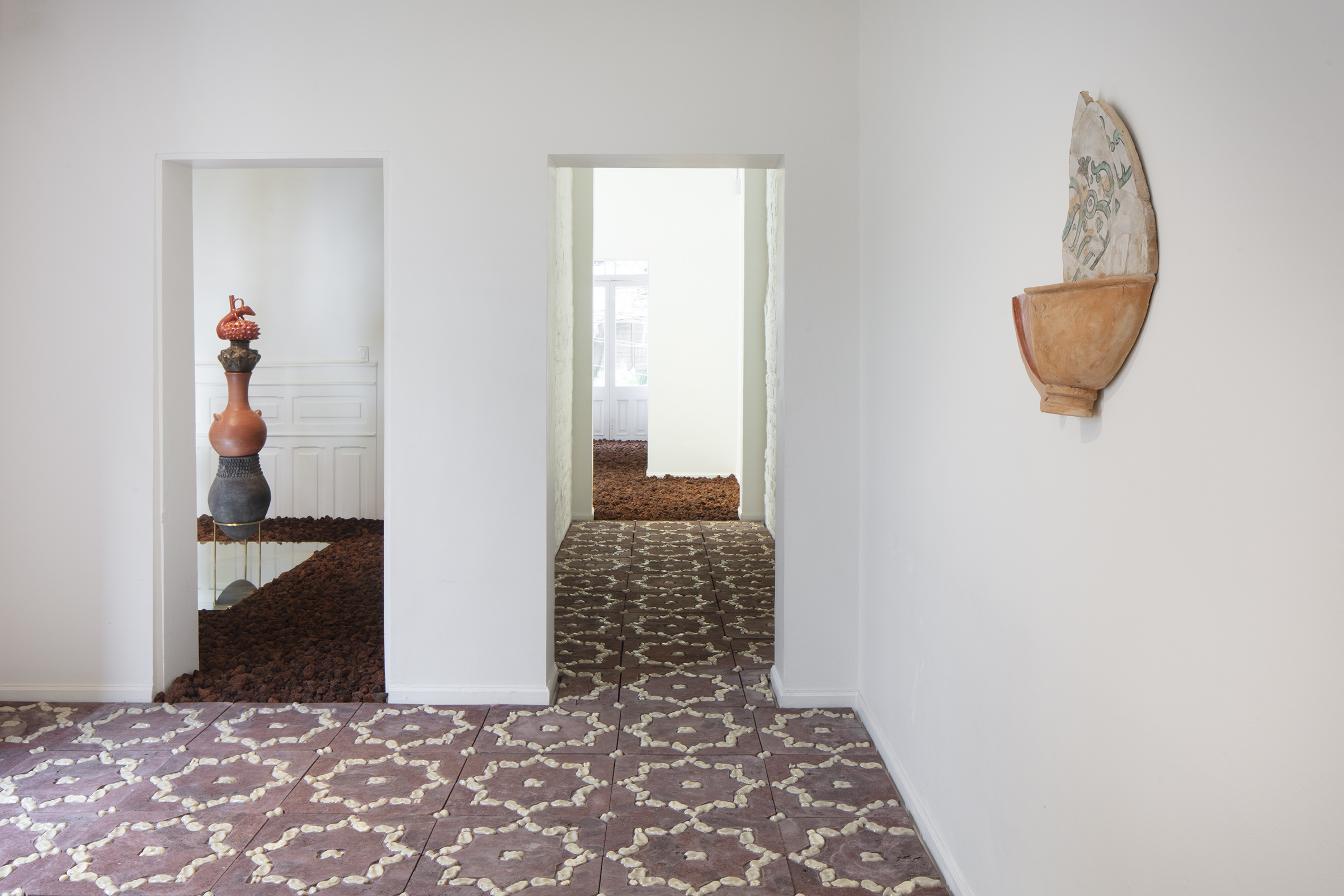
Asunción Molinos, 'De aquellos barros, estos lodos' (2026). General view at Travesía Cuatro. Photo by Ramiro Chaves, courtesy from the gallery.

In De aquellos barros, estos lodos, presented at Travesía Cuatro in Mexico City, artist Asunción Molinos and curator Claudia Llanza propose a journey through the traces of two cities whose past has been erased or rewritten by mechanisms of power. This is Molinos’s third exhibition in Mexico and her first in the capital, following her showing at the Museo MAZ in Zapopan in 2017 and another collaboration with Travesía Cuatro at its Guadalajara venue in 2022.

The starting point was a crossroads of personal and historical paths. Molinos’s fascination with Mexico’s cultural history coincided with research into the “erasures” of history on the Iberian Peninsula, especially of its Jewish, Muslim and Andalusi past. There she found a coincidence: the end of Al-Ándalus and the birth of the Spanish state took place alongside the destruction of Abya Yala. Together with Llanza, she decided to narrow such a vast subject, with caution and humility, to two cities: Mayrit, forerunner of present-day Madrid, and Tenochtitlán.

The title points to that continuity. Some are uncomfortable with revisiting events from five hundred years ago; Molinos thinks the opposite: “all of that is still alive,” and its synergies still shape how we inhabit places, how we relate to one another, and even how our taboos take form. These are not coincidences, she clarifies, but historical formulas that repeat in geographies marked by colonialism and the seizure of power.
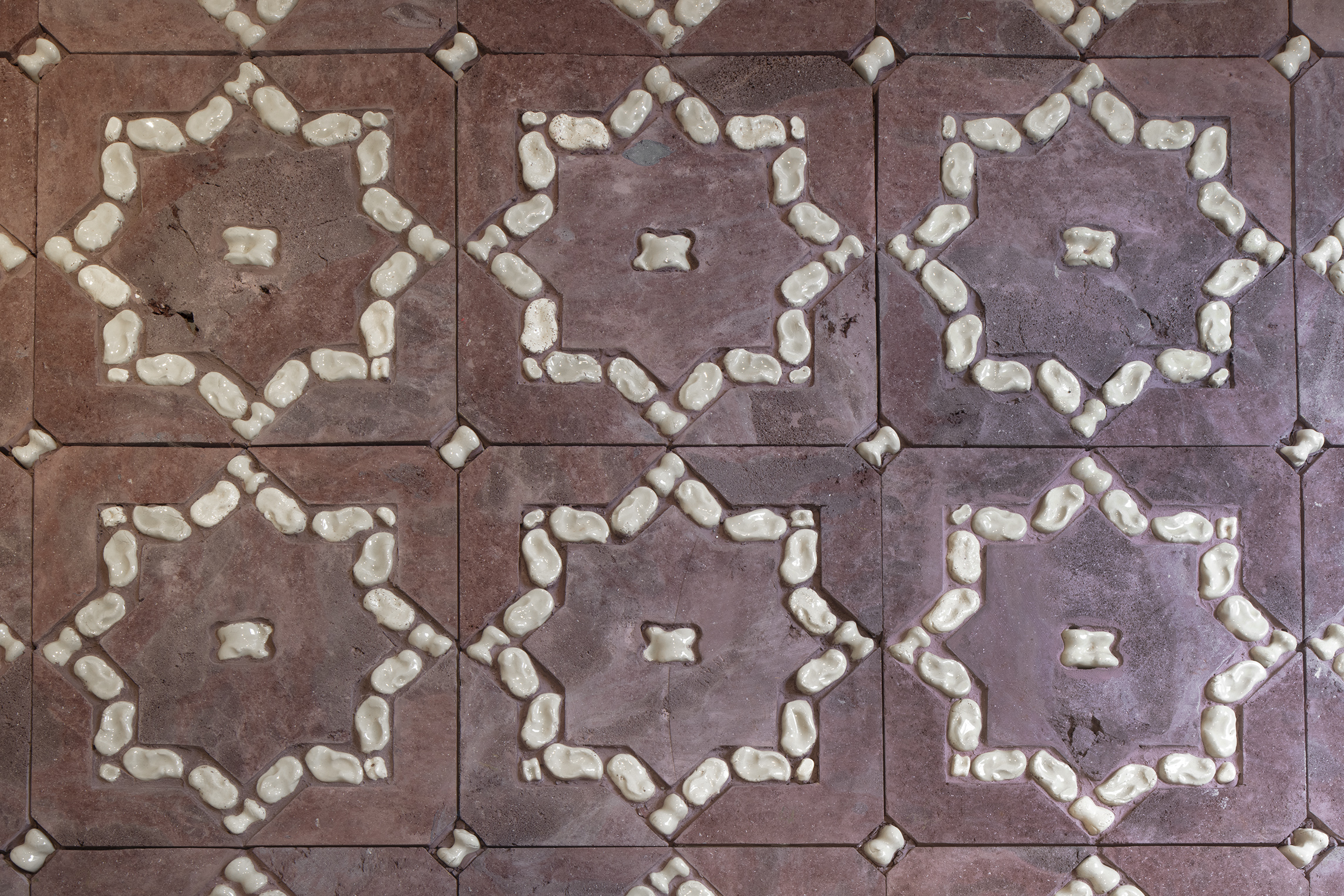
Asunción Molinos, '1521. Mayrit/Tenochtitlan' (2026). Photo by Ramiro Chaves, courtesy from Travesia Cuatro.

The piece that best condenses that idea is 1521 Mayrit-Tenochtitlán, a floor of tezontle slabs and reproductions of cattle astragali, the square bones once used as dice. It begins with a crisp pattern from Mexican Mudéjar: the eight-pointed star that in Islam evokes paradise and also the end of an order. With the passage of time and the visitors who walk across the piece, the star becomes disfigured and dismembered, fading until only a faint mark remains where the drawing can still be sensed. For the artist, 1521 marks the beginning of the end for both cities, and the piece speaks to the power of the vestige: remains hold a communicative capacity able to bring back interrupted stories that are still awaiting reparation.

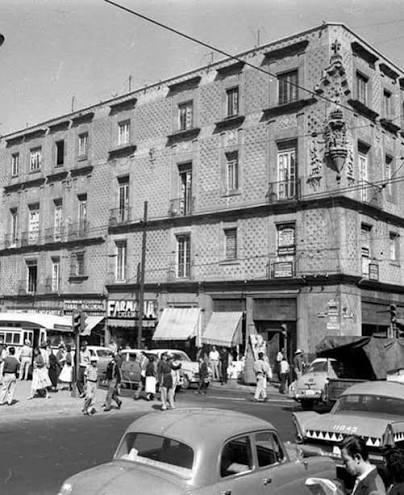
Her process begins with an intuition that, as the artistic research develops, is confirmed by shared experience. She recalls that, on a taxi ride to the Templo Mayor, she saw the Casa de las Ajaracas, clad in tezontle with the Mudéjar pattern across its entire façade: what she wanted to draw on the floor already existed. Laughing, she wonders whether it is an “artist’s fantasy,” but says she feels “at the service of the stories.” The true protagonist is that shared reality; the work, the curatorial framework and the artist herself are merely a bridge.

Casa de las Ajaracas, Mexico City.

Over seventeen years of practice, Molinos has developed what she calls peasant thinking (pensamiento campesino): the figure of the peasant farmer as an intellectual, a producer of knowledge through channels the academy does not always recognize. She comes from a peasant family and has learned from people who, even without knowing how to read or write, are “world-builders.” Her interest in interrupted cultures—the rural peninsular one, battered by the industrialization of agriculture, and those she encountered during eight years between Egypt and Oman—has revealed patterns that repeat whenever one order displaces another.

In Mexico City, audiences responded with surprise. The fiction of a homogeneous, white, Christian Spain has been so effective that its mixed origins have been obscured; few knew that Madrid is the only European capital of Muslim origin, a fact that, she says, “shifts the ground beneath many people.” Destructive powers, she maintains, destroy only up to a point: “the vital force of places always ends up returning.”

Her next project takes her to the Sephardic Museum in Toledo, alongside Chilean curator Andrea Pacheco, to explore the expulsion of Judeo-Arab families in 1492 and the places where they ended up. Faced with such sensitive subjects, she insists on always addressing a concrete event first and then seeing what echo it has in the present.

As she said goodbye, Molinos voiced a wish for the exhibition: that it spark each visitor’s curiosity to become a “small researcher” of their own life path, of their family portraits, neighborhoods and cities, because in that look backward lie the clues to what is coming. And a wish for a future where, she stresses, “it’s not okay to push anyone off the game board.”

De aquellos barros, estos lodos, by Asunción Molinos, was presented at Travesía Cuatro, Mexico City.

Get your daily dose of theory on design, art and tech—directly to your inbox.

Subscribe to our newsletter to receive The Orbiter, our monthly digest of what's new in the creative and inventive landscape.