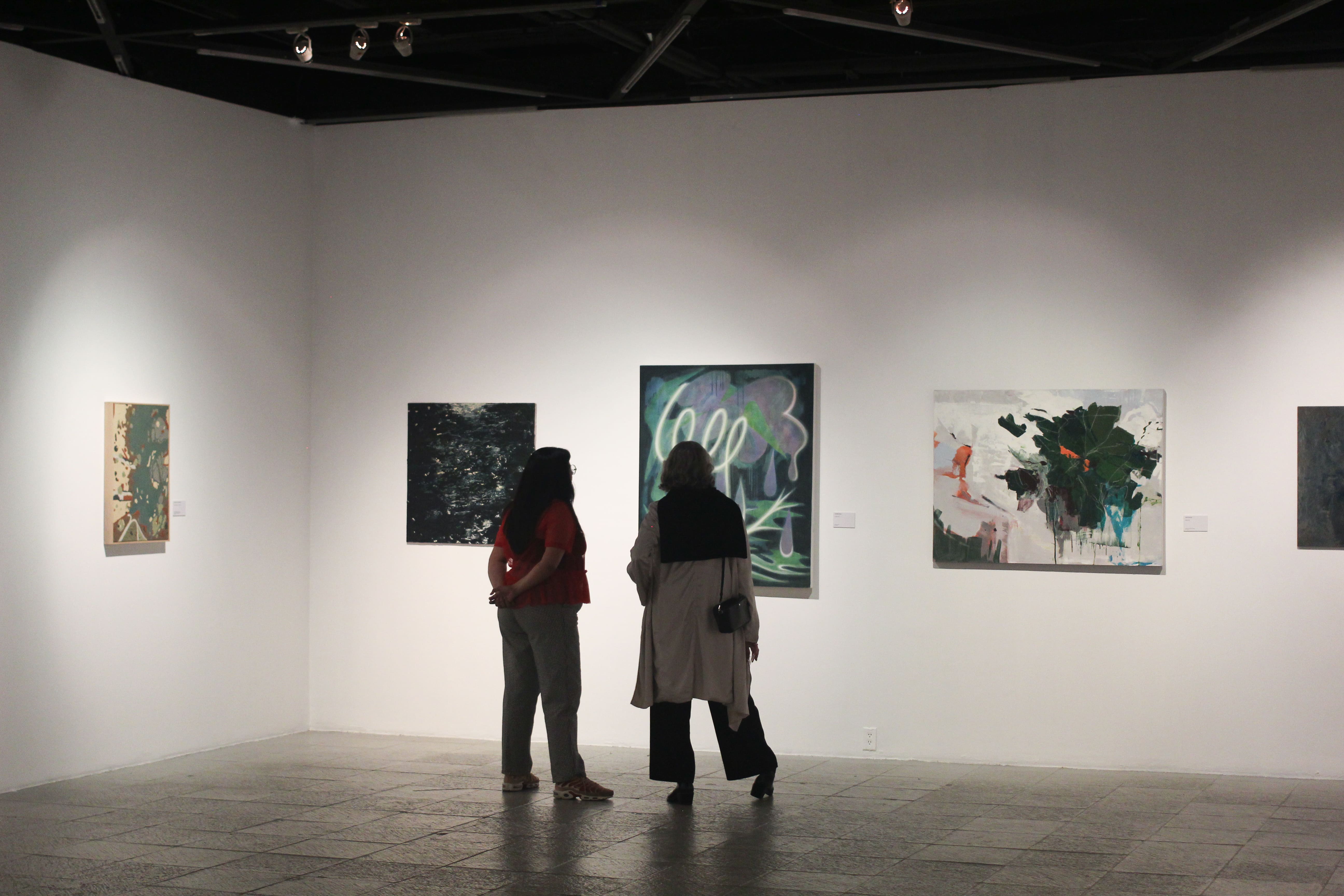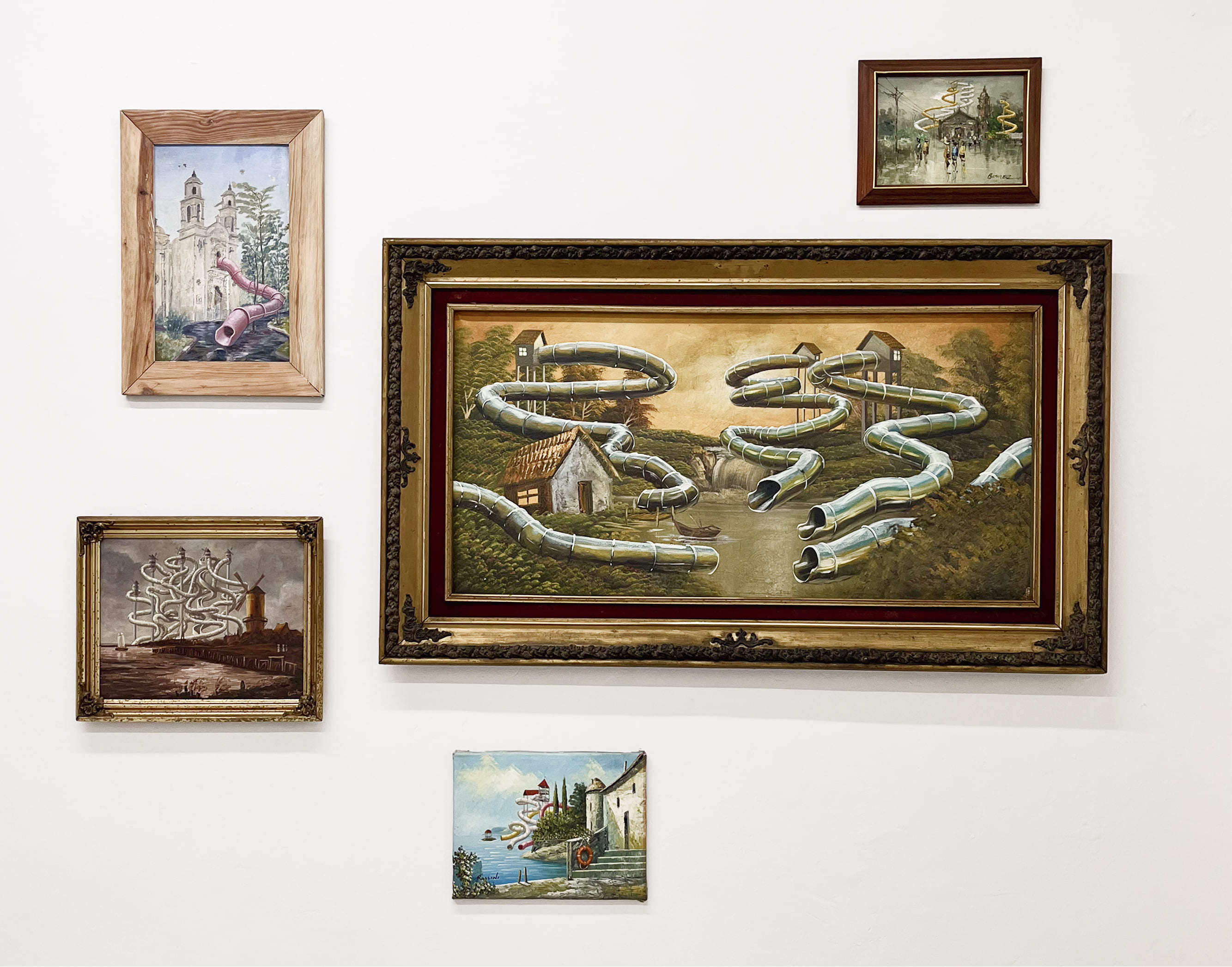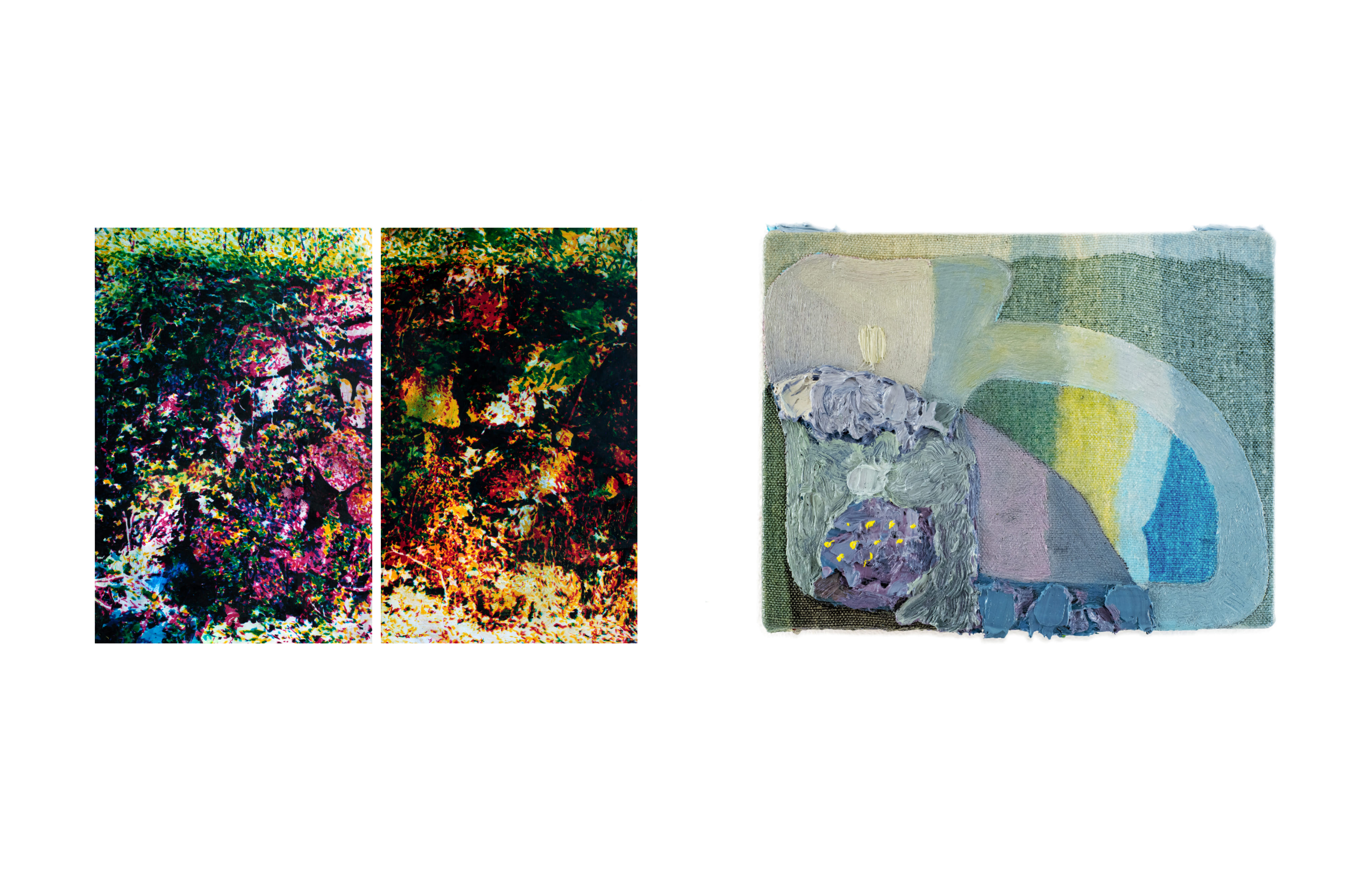
"Antiguo tecorral en Calamatlán" (2025) by Manolo Garibay (izquierda) and "Paisajes libres de plástico" (2026) by Catalina Gris. Images courtesy of I BPCS.
A question runs through the selection of participating and winning artists: What makes painting relevant today? What makes it relevant in Mexico? The usual answer appeals to technical innovation, which is true but insufficient. Whether through the advance of multiple forms of technology or through the artist's own skill, painting has overcome nearly all of its technical barriers, and in that exhaustion it seems necessary to return to a primitive state, prior to skill, where what matters is once again not only the content but also the function of the image. At the beginning of the twentieth century, Salomon Reinach argued in L'art et la magie ("Art and Magic") that the bison in Paleolithic caves were spells: by painting the animal, people sought to secure the hunt, that is, to act upon the world through its representation. The theory of magic art, later developed by Abbé Henri Breuil, has been widely debated by archaeologists, but it retains a powerful intuition: that the painted image, rather than describing reality, is an instrument for acting upon it.
Beyond the criticisms of that theory, the intuition of magic art resonates today, in a context where images are as abundant as they are devoid of meaning. In April of this year, the philosopher Carissa Véliz published an essay in The Economist suggesting that artificial intelligence has become the new Oracle of Delphi. Millions of people today consult ChatGPT the way the Greeks consulted the Pythia: they seek answers they cannot find on their own, without fully knowing how those answers are produced. Véliz warns that these systems are devoted to measuring the past, not to imagining what is to come. If the contemporary oracle is statistical and averages what has already been said, painting regains its condition as a magical or contemplative object: a slow, handmade surface that summons a state of reflection and projection.
Some of the winning pieces seem to sense this. A tecorral, a landscape without plastic, a humanity without a world: their titles and content work as invocations, as if painting the territory, the displacement of the natural order in favor of the artificial, or the sense of losing our place in the world were a way of giving form to realities that can only be understood through our humanity and the experience of being alive. If painting can be part of that counterweight, one that does not interpret reality through data but shapes present realities and imagines what is coming, what, then, do we want to imagine? What worlds do we want to summon through painting? Although it would be impossible to demand answers to such vast questions, the works presented in this first edition offer clues as to where we might be headed.
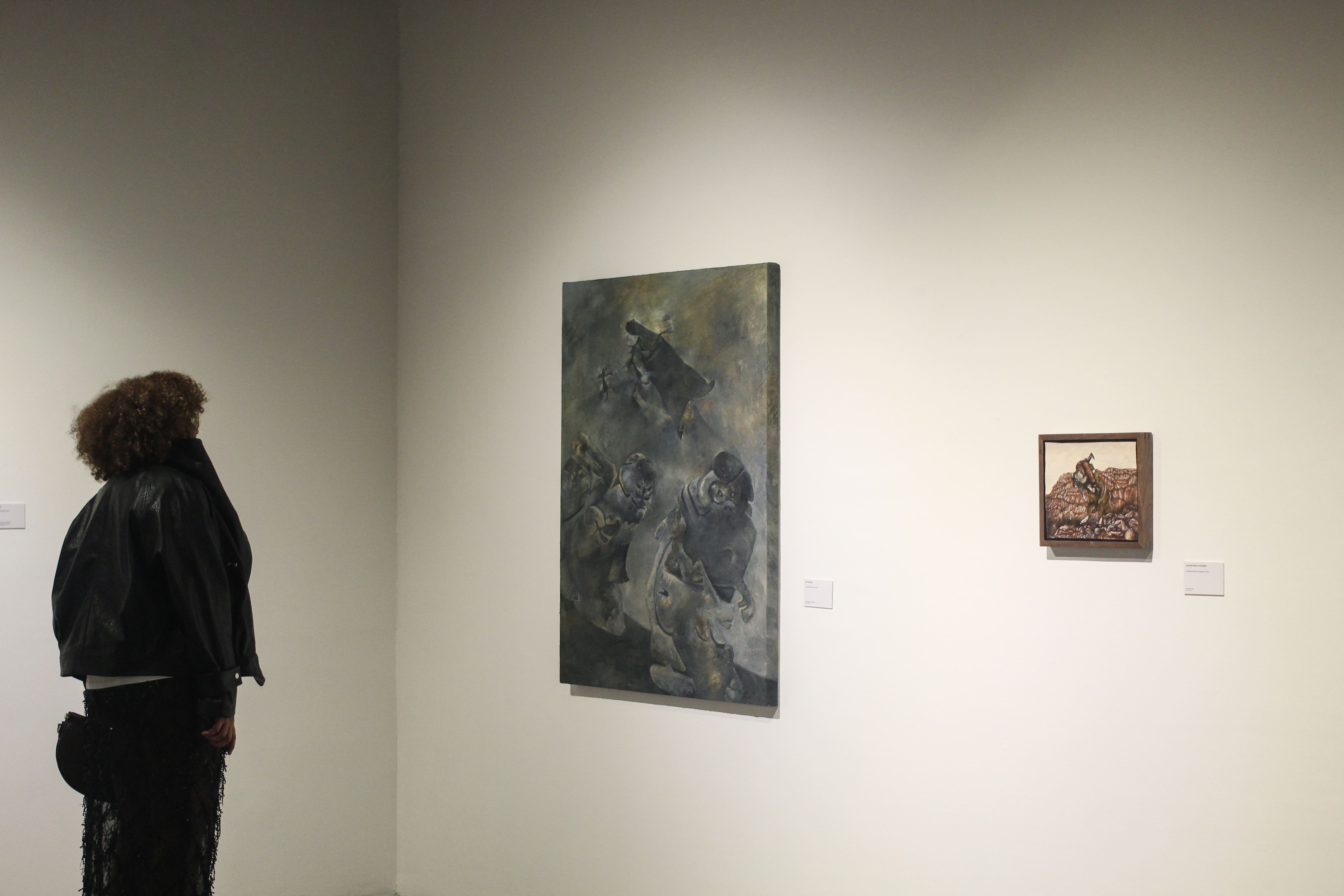
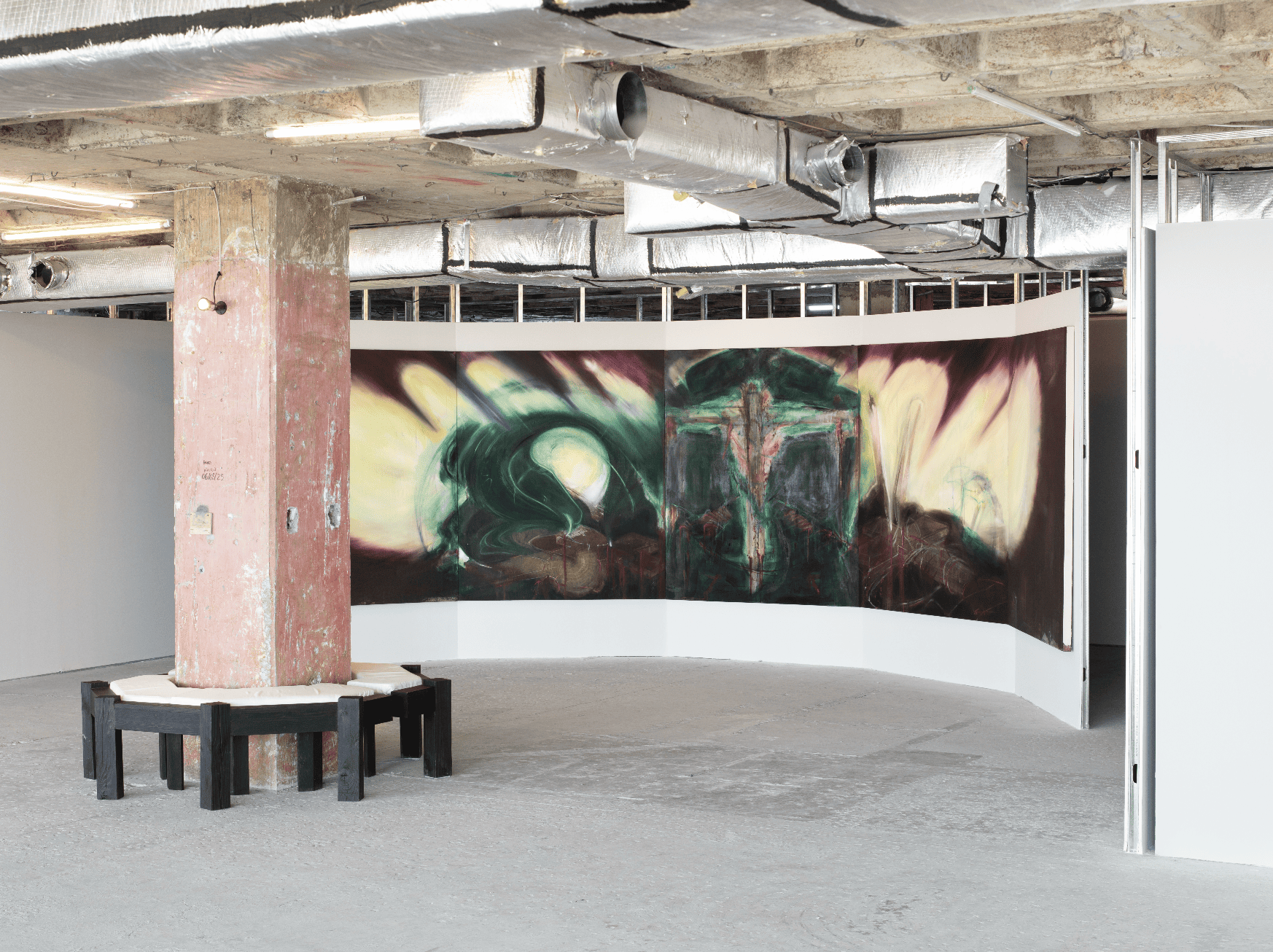
"Humanidad sin mundo" (2025) by Jou Morales at the I BPCS. Images courtesy of I BPCS.
The first clue lies in the territory and our passage through it. Manolo Garibay, winner of first place, starts from direct observation of the landscape in Antiguo tecorral en Calamatlán (Old Tecorral in Calamatlán, 2025), a diptych in ink, pigment, and acrylic resin on canvas. The tecorral, a dry-stone wall that commonly divides land in the Mexican countryside, appears as the trace of a relationship between nature and human presence. Garibay takes the logic of CMYK printing as his starting point, but applies each color manually, with brush, broad brush, and hand. The paradox is eloquent: a code designed for mechanical reproduction returned to the slow, imperfect gesture of the human hand. The result is a chromatic vibration that conveys an almost geological energy, a landscape that presents itself as a living system, fragmented and in constant transformation. Catalina Gris, in second place, takes the question to matter itself. Her first series in oil, the triptych Paisajes libres de plástico (Plastic-Free Landscapes, 2026), is painted in oil on hemp dyed with indigo and cempasúchil, the Mexican marigold, and prepared with a half-chalk ground, rabbit-skin glue, and dammar varnish. Renouncing the synthetic polymers that dominate contemporary painting becomes a stance: recovering the knowledge of the craft and the origins of color in order to think of a painting made solely of organic and natural materials. Indigo and cempasúchil, dyes with a long history in Mexico, turn the support itself into landscape. In third place, the work of Jou Morales shifts the clue from matter to fiction. Humanidad sin mundo (Humanity Without a World, 2025), oil and marble dust on canvas, offers a pictorial reinterpretation of passages from Ciencia ficción capitalista (Capitalist Science Fiction, 2024) by the writer Michel Nieva. The dystopias that science fiction novels and films imagined as the future appear here as the everyday reality of the Global South, and painting dismantles them in order to build other imaginaries. Morales proposes fiction as a material within our reach for articulating and shaping reality, and with that idea the circle opened by the magical way of thinking about art comes to a close: painting remains a way of acting upon the world, and it will have to remain so to stay relevant in our time, when images created by technology seem to paralyze rather than foster human thought and action.
Over its 120 years, Casa Serra has provided the materials needed to sustain the work of artists who gave Mexican art its identity at different moments of the twentieth century. Now, its first painting biennial seeks to create the conditions for the questions of the next generation of Mexican artists to emerge from the materiality of painting. Sites of memory, a return to matter, and fiction told from the realities of the Global South are three possible answers this edition of the BPCS leaves us, or, as we would like to see it, three ways of summoning a possible world.